Combination Skin: How to Find the Right Balance in Your Skincare Routine
Is your forehead already shiny by lunchtime, are your pores noticeable on your nose, while your cheeks are craving moisture after cleansing? And that's where the beauty dilemma begins.. 👀

10/27/2026
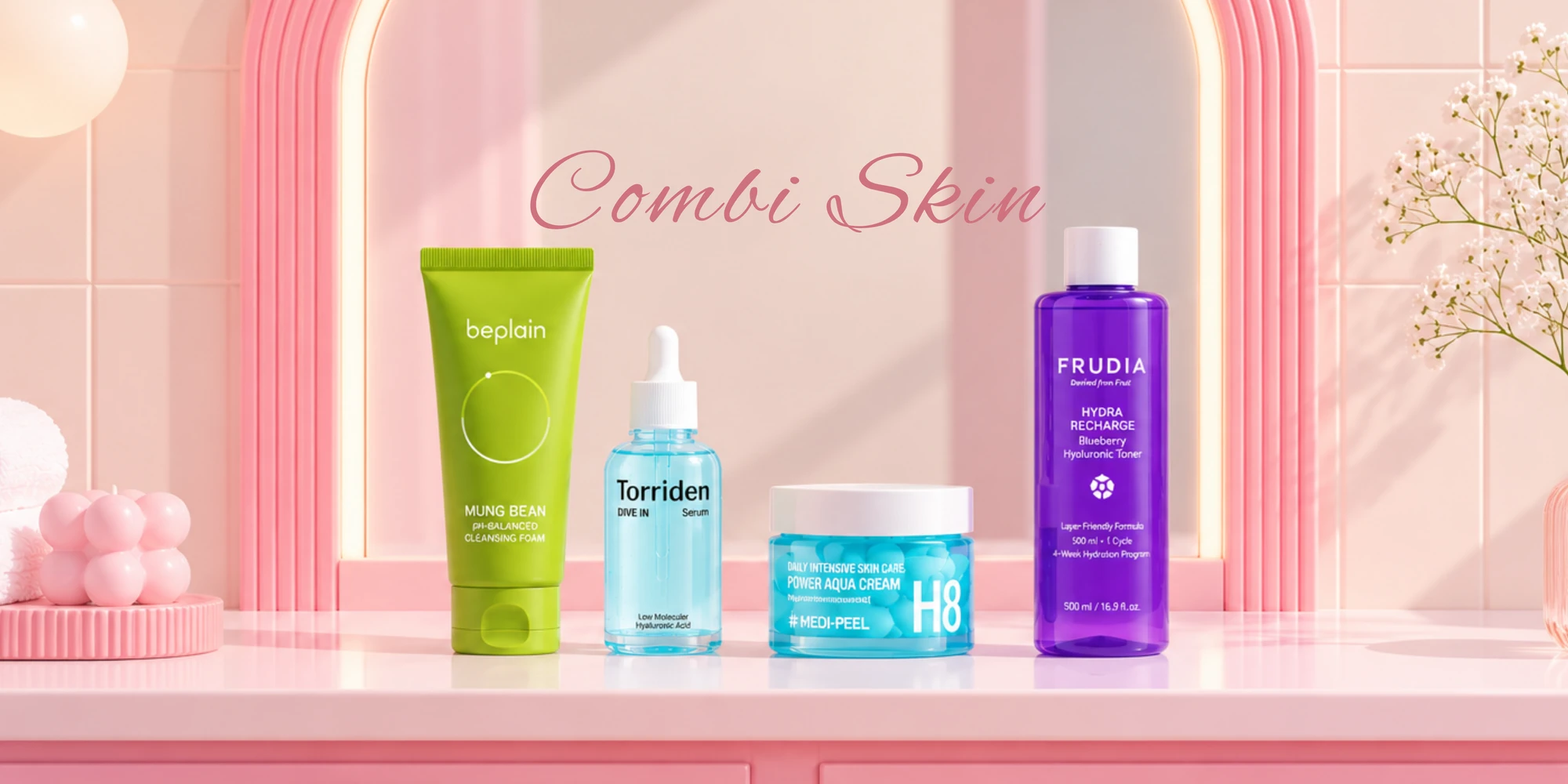
Article content1. What Is Combination Skin?2. Signs of Combination Skin: How to Check Your Skin Type3. Combination Skin Care: Five Essential Steps4. 1. Cleansing5. 2. Toning6. 3. Moisturizing and Multi-Zoning7. 4. Sun Protection8. 5. Extra Care: Multi-Masking9. Ingredients: What to Look for in Skincare Formulas10. Ingredients Worth Looking For11. How to Adjust Your Skincare Routine in Winter and Summer12. Conclusion
Is your forehead already shiny by lunchtime, are your pores noticeable on your nose, while your cheeks are craving moisture after cleansing? And that's where the beauty dilemma begins: should you choose a cream for oily skin or one for dry skin? 👀
Spoiler alert: you don't necessarily have to choose just one! If different areas of your face have different needs, there's a good chance you have combination skin.
The secret to skincare is finding the right balance: reducing excess shine in the T-zone without drying out your cheeks and providing comfortable hydration for your entire face.
Let's explore how to care for combination skin, which ingredients to look for in skincare formulas, and why the Korean approach of using different products for different areas of your face might become your new beauty favorite 💗
What Is Combination Skin?
Combination skin is a skin type in which the sebaceous glands have different levels of activity across different areas of the face. Some areas become oily more quickly, while others remain normal or tend to be dry.
This is most noticeable in the T-zone — the forehead, nose, and chin. Sebaceous glands are usually more active here, producing more sebum, which leads to shine and can make pores more visible.
The cheeks often produce less oil, so they may feel dry or tight. However, sebum distribution varies from person to person: not everyone's combination skin behaves the same way.
Combination skin type is largely determined by genetics. However, the season, hormonal changes, and skincare habits can also influence its condition 😌
Signs of Combination Skin: How to Check Your Skin Type
Not sure whether you really have combination skin? Try a quick test at home! ☝️
Step 1. Cleanse your skin. Wash your face with a gentle gel or foam cleanser and carefully pat it dry with a towel.
Step 2. Wait 30–60 minutes. Don't apply toner, serum, or moisturizer. Give your skin some time so you can assess its natural condition.
Step 3. Look in the mirror. Pay attention to oily shine, any feeling of tightness, and differences between individual areas of your face.
Now let's interpret the results:
- Oily skin: shine is noticeable across most areas of the face, including the cheeks.
- Dry skin: the skin feels tight and may be rough or prone to flaking.
- Combination skin: the T-zone looks shiny, while the cheeks remain matte, normal, or prone to dryness.
- Normal skin: there is no pronounced oily shine or dryness, and the skin generally feels comfortable.
But what about dehydrated skin? There's an important distinction here: combination skin is a skin type in which different areas of the face produce different amounts of sebum. Dehydration, on the other hand, is a condition in which the skin lacks water. That's why even an oily T-zone can look shiny while feeling tight at the same time.
💡 This test can help you roughly identify your skin type, but it doesn't replace a professional assessment. Cleansing products, weather conditions, and the condition of your skin barrier can influence the results. And remember: even oily or combination skin can be dehydrated or sensitive.
Combination Skin Care: Five Essential Steps
The golden rule is balance! There's no need to turn your forehead into a completely matte surface while covering your cheeks with the richest cream you can find 😅
Start with the basics: gentle cleansing, moisturizing, and sun protection. Then choose additional products according to your skin's needs.
1. Cleansing
Gentle gels or foam cleansers that remove impurities and excess sebum without leaving the skin feeling tight are suitable for combination skin. Focus on how comfortable your skin feels after cleansing rather than on individual ingredients alone. Even the presence of sulfates doesn't necessarily mean a product will be harsh: the overall formula matters.
Avoid overcleansing and hot water, which can worsen dryness and irritation. If you've been wearing SPF or long-lasting makeup, try double cleansing: first use a hydrophilic cleansing oil or balm, followed by a gentle gel or foam cleanser. However, if one product cleanses your skin effectively, an additional step isn't necessary.
Wondering where to start? Explore our selection of facial cleansers and choose a texture your skin loves 💗
2. Toning
After cleansing, you can add a toner to help maintain your skin's hydration and comfort 💧
For everyday use, look for formulas containing glycerin, panthenol, hyaluronic acid, or centella. And what about salicylic acid? If your T-zone is prone to clogged pores, a BHA product can be a useful addition. Depending on the formula and your skin's needs, you can apply it to specific areas. Introduce it gradually and monitor your skin's response.
Want to add a little hydration to your routine? Check out our selection of facial toners.
3. Moisturizing and Multi-Zoning
Here's an interesting beauty trick for combination skin — multi-zoning! 💗
Multi-zoning is a skincare approach in which you use different products on specific areas of your face according to their individual needs.
For example, you can choose a lightweight gel or fluid with niacinamide for your T-zone. This ingredient helps support the skin barrier and, in certain formulas, may help reduce excess oiliness.
For dry cheeks, richer textures containing ceramides, panthenol, squalane, beta-glucan, or ectoin may be suitable. These ingredients help maintain hydration, soften the skin, and strengthen its protective barrier.
Looking for comfortable hydration for your skin? Discover our selection of moisturizers for combination skin that deserve your attention.
4. Sun Protection
SPF is an essential hero of your daytime skincare routine, regardless of your skin type 🌞
Lightweight sunscreen fluids, gels, or creams that don't leave an excessively greasy feeling are often comfortable for combination skin. However, a rich texture doesn't automatically mean a product will clog pores.
Choose a broad-spectrum sunscreen with SPF 30 or higher. Apply a sufficient amount and reapply according to the instructions, especially when spending extended periods outdoors.
And yes, SPF is important in winter too: UVA radiation is present throughout the year, although UVB intensity varies depending on the season.
Discover our selection of sunscreens that might become your everyday beauty favorites 💗
5. Extra Care: Multi-Masking
If multi-zoning already sounds interesting, meet its beauty bestie — multi-masking 🧖♀️
Multi-masking means applying different face masks to different areas of your face during the same skincare session.
For example:
- On the T-zone — a clay mask that helps absorb excess sebum.
- On the cheeks — a hydrating mask to help maintain comfort.
- On areas prone to irritation — a formula containing panthenol or centella.
But this step isn't essential! Use masks only if your skin genuinely needs them. How often you use them depends on the product's ingredients, the manufacturer's instructions, and your skin's individual tolerance. Don't leave a clay mask on longer than recommended. If you experience dryness, tightness, or irritation, reduce how frequently you use it.
A selection of face masks for your at-home beauty routine! Choose an all-purpose formula or experiment with multi-masking 💅
And to make building your beauty routine even easier, explore our selection of products for combination skin. You'll find everything you need to care for your skin according to its individual needs 💗
Ingredients: What to Look for in Skincare Formulas
Getting familiar with INCI lists can be helpful, but there's no need to turn it into a hunt for "good" and "bad" ingredients 🔎
For combination skin, what matters is the overall formula, the concentration of ingredients, and how the product actually performs on your skin.
Ingredients Worth Looking For
- Niacinamide. Helps support the skin barrier, while some formulas containing it may help reduce excess oiliness.
- Hyaluronic acid and beta-glucan. Help retain moisture and maintain skin hydration without the need for rich textures.
- Salicylic acid (BHA). Helps exfoliate dead skin cells and may help reduce the appearance of clogged pores.
- PHA acids. Provide gentle exfoliation and may be an alternative to other acids if your skin doesn't tolerate intensive exfoliation well.
- Centella, panthenol and ectoin. Help maintain skin comfort, hydration, and its protective barrier.
- Ceramides and squalane. Help soften the skin, support its protective barrier, and reduce moisture loss, especially in dry areas.
💡 Don't evaluate a product based solely on its ingredient list. Pay attention to the results too — whether your skin feels comfortable and whether there's any tightness or irritation.
How to Adjust Your Skincare Routine in Winter and Summer
Combination skin can behave differently depending on the season. And that's completely normal!
In winter ❄️ Cold outdoor air and dry indoor air caused by heating can increase feelings of tightness. If your cheeks become drier, try a richer moisturizer containing ceramides and emollient ingredients. And if irritation appears, consider temporarily reducing how often you use acids and other potentially irritating active ingredients.
In summer ☀️ During warmer weather, oily shine may become more noticeable, so lightweight gels, fluids, and emulsions can sometimes feel more comfortable. But don't forget about hydration and SPF. By the way, air conditioning in summer, just like heating in winter, can reduce indoor humidity and affect your skin's condition.
So don't rely on the calendar alone — pay attention to how your skin feels!
Conclusion
Combination skin has its own unique characteristics because different areas of the face may need different approaches to skincare. And the key is finding the right balance 🌿 The T-zone often feels more comfortable with lightweight textures, while the cheeks may sometimes need extra hydration and softness. However, that doesn't mean you necessarily need a separate product for every area.
Multi-zoning and multi-masking can complement your routine, but the foundation remains simple: gentle cleansing, moisturizing, and sun protection.
And remember: you don't need to make every part of your face behave the same way — you just need to learn to understand your skin's needs 💗
This translation is AI-generated, so there might be some minor slip-ups 😌
Did you like the article?
support the author
1 likes